
Friday, February 22, 2013
Back from CODEX, Back to Work
After another exhilarating CODEX International Book Fair &
Symposium, I am slowly easing back into the studio. 4,000 of the 5,000
sheets of paper for the standard edition of Interstices & Intersections
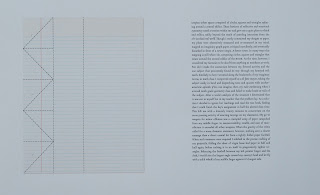
arrive on Monday and I am continuing with the drawing of all 450 of
Euclid's proofs. For this purpose I have had pale gray graphs printed on
90lb watercolor paper. I will be drawing the proofs in four page
imposition so that they can eventually be bound into 13 volumes for easy
reference. Here's a look at the loose title page of volume one.


Back from CODEX, Back to Work
After another exhilarating CODEX International Book Fair &
Symposium, I am slowly easing back into the studio. 4,000 of the 5,000
sheets of paper for the standard edition of Interstices & Intersections
arrive on Monday and I am continuing with the drawing of all 450 of
Euclid's proofs. For this purpose I have had pale gray graphs printed on
90lb watercolor paper. I will be drawing the proofs in four page
imposition so that they can eventually be bound into 13 volumes for easy
reference. Here's a look at the loose title page of volume one.
Sunday, January 13, 2013
Interstices & Intersections
In the frantic run-up to the CODEX Book Fair and Symposium,
I have been proofing some early spreads from my upcoming Euclid book.
In the process I have been tossing around some possible title ideas.
Serious contenders thus far have been "Therefore Etc.," "Extreme and
Mean," "Syllogisms," and "Euclid Avenue." For the time being I have
settled on: Interstices & Intersections or, An Autodidact Comprehends a Cube.
Below are samples of what I have done so far, representing Propositions
i.19; iii.1; iv.6; and xiii.17. (The large blank spaces are where
as-yet-unwritten text will go.) Keep in mind that these are early proofs
from a project that has another year, at least, yet in the making, so
anything is open to change during that time. Tomorrow I will bring the
sheets up to Daniel Kelm in Easthampton, Massachusetts so that he can
bind a mock-up for the fair.







Tuesday, December 18, 2012
Thirteen Euclidean Propositions
I have begun work on a new project investigating and interacting with a selection of thirteen propositions from Euclid's Elements.
Chosen not for their relationship to each other but for their relevance
in my life, the thirteen propositions will be printed with accompanying
diagrammatics and paired with a companion textual and visual commentary
of my own. The book is in the very early stages of reading, sketching,
writing, and proofing, but it already promises to involve the most
complex printing I have attempted to date. The few spreads that I have
designed so far require ten to fourteen press runs each, involving any
number of materials and processes including hand set type, ornaments,
rules, polymer plates, woodblock, and pochoir. The book will be hand set
in my proprietary typefaces, Gremolata and Cancellaresca Milanese,
newly engraved and cast by Micah Currier at the Dale Guild Type Foundry, and Daniel Kelm will be binding the book in a new structure of his design.
While many people develop a kind of nervous tick at the mention of geometry, flashing back to the schoolhouse frustrations typically associated with maths, the geometry classroom, above all others, was enormously creative for me. I was a disastrous student in general but in mathematical subjects I experienced a natural fluency, one that was tested when I entered tenth grade geometry. Frustrated with my incompetent teacher and my resulting grades, I took to reading the text book rather than paying attention in class. My grades and comprehension quickly improved and it soon became apparent that in geometry I had found my life's metier. I also discovered the method by which I would pursue any future studies: reading books and drawing. Since that first brush with geometry I have used what I learned in that text book to draw letters, design books, develop ornaments and patterns—all of the things that I love most to do.
My method for working on Thirteen Propositions is similar to my method in the tenth grade. I am beginning by reading and drawing proofs for all the propositions in Euclid's thirteen books. Along the way, certain propositions stand out as having a particular interest or relevance: they spark associations in literature, letter forms, or life (or all three). I then begin to develop visual ideas, write bits of text, and begin reading other books that might inspire or relate to the proposition at hand. My thought at this point is that each proposition will involve a work of Greek literature but it is too early to tell if that will be the case. While some of the reading is great fun, the Iliad, David Copperfield, Edith Hamilton, Euclid, etc., some is less thrilling. Just a few days ago I received a copy of a ninth grade algebra text book that sent strange shivers through my body, an uncomfortable electrical current connecting me with my awkward thirteen year old self. Thankfully, I am able to read through a chapter a day, meaning that it will be a quick torture. There are only fourteen chapters.

Simultaneously with these studies, I am conducting a survey of a few hundred editions of Euclid, beginning with Erhardt Ratdolt's edition of 1482 and ending with editions from the last few years. For those of you who are unfamiliar with the structure of the Elements, there are thirteen books comprising roughly twenty to fifty propositions. Each of the propositions begins with an enunciation of what is meant to be proven, followed by the proof and conclusion which are illustrated by a line diagram. These diagrams have remained constant for hundreds of years and so it is interesting to see how designers and printers have tried to distinguish their edition from others—you can tell instantly if the printer had fun with geometry or took it a little too seriously. Below I've attached just two examples. The first is from Paganius Paganinus' 1509 edition edited by Fra Luca Pacioli and it is pretty much exactly what one would expect from a Humanistic friar: tall slender columns of uninterupted text with the squares, trapezia, etc. tucked safely in the margins. The second is published by John Daye in London in 1590, showing his lovely little pull-up illustrations from Book XI. Daye's is closer to the spirit which I will try to evoke in my edition.


While many people develop a kind of nervous tick at the mention of geometry, flashing back to the schoolhouse frustrations typically associated with maths, the geometry classroom, above all others, was enormously creative for me. I was a disastrous student in general but in mathematical subjects I experienced a natural fluency, one that was tested when I entered tenth grade geometry. Frustrated with my incompetent teacher and my resulting grades, I took to reading the text book rather than paying attention in class. My grades and comprehension quickly improved and it soon became apparent that in geometry I had found my life's metier. I also discovered the method by which I would pursue any future studies: reading books and drawing. Since that first brush with geometry I have used what I learned in that text book to draw letters, design books, develop ornaments and patterns—all of the things that I love most to do.
My method for working on Thirteen Propositions is similar to my method in the tenth grade. I am beginning by reading and drawing proofs for all the propositions in Euclid's thirteen books. Along the way, certain propositions stand out as having a particular interest or relevance: they spark associations in literature, letter forms, or life (or all three). I then begin to develop visual ideas, write bits of text, and begin reading other books that might inspire or relate to the proposition at hand. My thought at this point is that each proposition will involve a work of Greek literature but it is too early to tell if that will be the case. While some of the reading is great fun, the Iliad, David Copperfield, Edith Hamilton, Euclid, etc., some is less thrilling. Just a few days ago I received a copy of a ninth grade algebra text book that sent strange shivers through my body, an uncomfortable electrical current connecting me with my awkward thirteen year old self. Thankfully, I am able to read through a chapter a day, meaning that it will be a quick torture. There are only fourteen chapters.

Simultaneously with these studies, I am conducting a survey of a few hundred editions of Euclid, beginning with Erhardt Ratdolt's edition of 1482 and ending with editions from the last few years. For those of you who are unfamiliar with the structure of the Elements, there are thirteen books comprising roughly twenty to fifty propositions. Each of the propositions begins with an enunciation of what is meant to be proven, followed by the proof and conclusion which are illustrated by a line diagram. These diagrams have remained constant for hundreds of years and so it is interesting to see how designers and printers have tried to distinguish their edition from others—you can tell instantly if the printer had fun with geometry or took it a little too seriously. Below I've attached just two examples. The first is from Paganius Paganinus' 1509 edition edited by Fra Luca Pacioli and it is pretty much exactly what one would expect from a Humanistic friar: tall slender columns of uninterupted text with the squares, trapezia, etc. tucked safely in the margins. The second is published by John Daye in London in 1590, showing his lovely little pull-up illustrations from Book XI. Daye's is closer to the spirit which I will try to evoke in my edition.


Monday, December 10, 2012
A preview of what's in the works

I will be announcing the book more formally in a couple of months but in the meantime here is a preview from the sketching/proofing phase of my upcoming collaboration with Euclid.
Friday, September 28, 2012
Swan & Hoop 3: A Meditation in Rome chosen as one of the 50 books of the year
My recent publication Swan & Hoop 3: A Meditation in Rome
by Paul F. Gehl was just chosen as one of the AIGA/Design Observer 50
Books of the Year. You can view all of the winning books on the Design Observer website.


Friday, August 10, 2012
Forthcoming Publication: The Book of Jonah
I am currently working on a small edition of The Book of Jonah,
hand-set in my typeface Nicolas and printed on a special making of
Twinrocker Handmade Paper. The story of Jonah is one to which I have
returned repeatedly, though I had no specific plans to print it until I
acquired a large font of Nicolas from the Dale Guild Type Foundry last
year. Inspired by the twelfth century enamel lettering of Nicolas of
Verdun, the letterforms in Nicolas are designed to embody a physical
content as well as convey a literary one—they are spiky, voluptuous
letters that would be ill-suited for most commercial book work. Cast at a
large size of 24pt, the typeface would typically be considered a
titling face but my intention when designing it was that it would be
used for continuous text. After living with the font for a few months I
began experimenting with various settings and page proportions. It
quickly became apparent that Jonah was the right text for the alphabet.
The pages of the book are oblong, measuring eleven inches wide by ten inches tall, and are composed with a nod to early Biblical manuscripts. The type forms are inked in migrating shades of blue ink, conceived as a visual descent into and eventual reprieve from darkness over the course of the book. Eighty copies will be printed in advance of October, 2012.

Opening spread of The Book of Jonah.
* * * * * * * * * * * * * * * * * * * *
To sum up the story: the word of God comes to Jonah and tells him to travel from an undisclosed location to the city of Nineveh and cry against its wickedness. Instead, Jonah flees to Joppa and boards a boat for Tarshish. God sends down a mighty tempest striking fear into all but Jonah, who is sleeping down below. The sailors draw lots to discover the cause of the turmoil and the lot falls upon Jonah who, after telling his story to the sailors, suggests that he be tossed overboard so that the sea will be calm. Rather than take Jonah's life, the sailors try unsuccessfully to row to shore, after which they beseech God to neither kill them nor make them kill Jonah. God remains implacable. The sailors pitch Jonah over, the sea becomes calm, the sailors make sacrifices and vows.
Meanwhile, below, God has prepared a great fish to swallow Jonah up. While in the belly of the fish, Jonah offers a prayer as if he had already been released from the fish, pledging to hold true to his vows. After three days and three nights, God has the fish vomit Jonah onto shore.
Once again the word of God comes to Jonah, commanding him to go to Nineveh and preach against it, which he does in a remarkably terse manner: "Yet forty days, and Nineveh shall be overthrown." Message received, all the inhabitants, king and peasant alike (and their livestock), cover themselves in sackcloth, refrain from food and drink, and cry to God, promising to turn from evil and violence. Seeing their sincerity, God repents of the evil he has said he would do to them and spares Nineveh his wrath.
Contrary to expectations, Jonah is beside himself with anger, saying that he fled to Tarshish initially because he knew that God was gracious and merciful and would repent his evil pledge. In a peculiar narrative leap, Jonah then beseeches God to take his life from him. God refuses and Jonah sets up a "booth" outside the city walls so that he might see what will become of Nineveh. God causes a gourd tree to grow to provide Jonah with shade, only to set a worm to destroy it the following night. He then causes a blistering sun and hot wind to beat upon Jonah until he faints with heat and prays for death. To this prayer, God responds that if Jonah should pity the gourd ought not the Lord pity the people of Nineveh and their cattle? Here the book ends.
Although the bit about the belly of the fish gets all the press, the central narrative conflict of The Book of Jonah concerns Jonah's reaction to the call to prophecy. It is not a simple reaction. First he flees from God's sight and displays no signs of regret for having disobeyed Him, easily sleeping while the tempest roils around him. (Later we learn that Jonah's equipoise may have derived from his belief that God would not commit "the evil" against Nineveh anyway, so Jonah's services as prophet were unnecessary.) When called the second time, Jonah enacts God's commandment with a minimum of effort and then cries angrily that his evil prophecy was not fulfilled (if that is, in fact, why he is angry). First you have me swallowed by a fish, then you make me trudge all the way out here to tell these people that you are going to destroy them, and then you don't destroy them! Just kill me now!
Despite these convoluted scenarios it is hard to believe that The Book of Jonah is really about Nineveh at all. Or more precisely, if the purpose of the prophecy is to instruct Nineveh, there is no story to tell—one little peep from Jonah and the whole city mends its ways. The story is all action with little or no character development, two odd prophetic tales tenuously balanced on the fulcrum of Jonah's transformative experience in the belly of the fish. The real narrative cargo of The Book of Jonah is how Jonah learns (or can learn) from his own prophecy.
* * * * * * * * * * * * * * * * * * * *
As with all Biblical books, each careful reader of The Book of Jonah has their own interpretation or point of access. When I read the text, I interpret it as a parable for the transformation from adolescence to adulthood. The stage for this reading is set in the first chapter when the lot falls upon Jonah and the sailors interrogate him thus: Tell us, we pray thee, for whose cause this evil is upon us; What is thine occupation? and whence comest thou? what is thy country? and of what people art thou? These formative existential questions set a tone for the succeeding narrative: who are you? what do you believe in? Each character in the story, including God, is called upon to answer these questions through their actions. Throughout the text, Jonah vacillates between cluelessness and insight, blithely ignoring God's will one moment, displaying a near-omnipotent understanding of God's limitations the next. What better model of an adolescent is there than one whose lack of worldly understanding is shot through with occasional flashes of native wisdom? Jonah's reactions to God's commandments, in all their petulance and pluck, are the reactions of a child, and the lessons he is learning are necessary for his transition to adulthood. Chief among these lessons is empathy. Jonah's early willingness to sacrifice his life for those of the other sailors, the sailors' attempts to row to shore rather than kill Jonah, Jonah's (enforced) comparison of his own plight with those of the people of Nineveh, God's empathy for Jonah (preparing the fish as passage to shore) as well as for the people of Nineveh—all of these episodes illuminate a central theme of the story, the extreme brevity of which deprives us the satisfaction of knowing whether these lessons bore enduring fruit. Maybe Jonah learns important life lessons. Maybe he just goes on sulking, being angry unto death.
And then, of course, there is the fish. The fact that Jonah was in the belly of the fish for three days and three nights prior to being regurgitated onto dry land provided a deeper prophetic resonance to the story for early Christians. While that particular reading does not resonate with me, the less loaded idea of a transformative second chance does. For all of its drama, The Book of Jonah is a hopeful text in which even God reconsiders his actions and repents for his wrongdoing. Transformation waits at the ready as a perpetual Plan B, suggesting a more nuanced reality than simplistic tales of good and evil typically allow.
The pages of the book are oblong, measuring eleven inches wide by ten inches tall, and are composed with a nod to early Biblical manuscripts. The type forms are inked in migrating shades of blue ink, conceived as a visual descent into and eventual reprieve from darkness over the course of the book. Eighty copies will be printed in advance of October, 2012.

Opening spread of The Book of Jonah.
* * * * * * * * * * * * * * * * * * * *
To sum up the story: the word of God comes to Jonah and tells him to travel from an undisclosed location to the city of Nineveh and cry against its wickedness. Instead, Jonah flees to Joppa and boards a boat for Tarshish. God sends down a mighty tempest striking fear into all but Jonah, who is sleeping down below. The sailors draw lots to discover the cause of the turmoil and the lot falls upon Jonah who, after telling his story to the sailors, suggests that he be tossed overboard so that the sea will be calm. Rather than take Jonah's life, the sailors try unsuccessfully to row to shore, after which they beseech God to neither kill them nor make them kill Jonah. God remains implacable. The sailors pitch Jonah over, the sea becomes calm, the sailors make sacrifices and vows.
Meanwhile, below, God has prepared a great fish to swallow Jonah up. While in the belly of the fish, Jonah offers a prayer as if he had already been released from the fish, pledging to hold true to his vows. After three days and three nights, God has the fish vomit Jonah onto shore.
Once again the word of God comes to Jonah, commanding him to go to Nineveh and preach against it, which he does in a remarkably terse manner: "Yet forty days, and Nineveh shall be overthrown." Message received, all the inhabitants, king and peasant alike (and their livestock), cover themselves in sackcloth, refrain from food and drink, and cry to God, promising to turn from evil and violence. Seeing their sincerity, God repents of the evil he has said he would do to them and spares Nineveh his wrath.
Contrary to expectations, Jonah is beside himself with anger, saying that he fled to Tarshish initially because he knew that God was gracious and merciful and would repent his evil pledge. In a peculiar narrative leap, Jonah then beseeches God to take his life from him. God refuses and Jonah sets up a "booth" outside the city walls so that he might see what will become of Nineveh. God causes a gourd tree to grow to provide Jonah with shade, only to set a worm to destroy it the following night. He then causes a blistering sun and hot wind to beat upon Jonah until he faints with heat and prays for death. To this prayer, God responds that if Jonah should pity the gourd ought not the Lord pity the people of Nineveh and their cattle? Here the book ends.
Although the bit about the belly of the fish gets all the press, the central narrative conflict of The Book of Jonah concerns Jonah's reaction to the call to prophecy. It is not a simple reaction. First he flees from God's sight and displays no signs of regret for having disobeyed Him, easily sleeping while the tempest roils around him. (Later we learn that Jonah's equipoise may have derived from his belief that God would not commit "the evil" against Nineveh anyway, so Jonah's services as prophet were unnecessary.) When called the second time, Jonah enacts God's commandment with a minimum of effort and then cries angrily that his evil prophecy was not fulfilled (if that is, in fact, why he is angry). First you have me swallowed by a fish, then you make me trudge all the way out here to tell these people that you are going to destroy them, and then you don't destroy them! Just kill me now!
Despite these convoluted scenarios it is hard to believe that The Book of Jonah is really about Nineveh at all. Or more precisely, if the purpose of the prophecy is to instruct Nineveh, there is no story to tell—one little peep from Jonah and the whole city mends its ways. The story is all action with little or no character development, two odd prophetic tales tenuously balanced on the fulcrum of Jonah's transformative experience in the belly of the fish. The real narrative cargo of The Book of Jonah is how Jonah learns (or can learn) from his own prophecy.
* * * * * * * * * * * * * * * * * * * *
As with all Biblical books, each careful reader of The Book of Jonah has their own interpretation or point of access. When I read the text, I interpret it as a parable for the transformation from adolescence to adulthood. The stage for this reading is set in the first chapter when the lot falls upon Jonah and the sailors interrogate him thus: Tell us, we pray thee, for whose cause this evil is upon us; What is thine occupation? and whence comest thou? what is thy country? and of what people art thou? These formative existential questions set a tone for the succeeding narrative: who are you? what do you believe in? Each character in the story, including God, is called upon to answer these questions through their actions. Throughout the text, Jonah vacillates between cluelessness and insight, blithely ignoring God's will one moment, displaying a near-omnipotent understanding of God's limitations the next. What better model of an adolescent is there than one whose lack of worldly understanding is shot through with occasional flashes of native wisdom? Jonah's reactions to God's commandments, in all their petulance and pluck, are the reactions of a child, and the lessons he is learning are necessary for his transition to adulthood. Chief among these lessons is empathy. Jonah's early willingness to sacrifice his life for those of the other sailors, the sailors' attempts to row to shore rather than kill Jonah, Jonah's (enforced) comparison of his own plight with those of the people of Nineveh, God's empathy for Jonah (preparing the fish as passage to shore) as well as for the people of Nineveh—all of these episodes illuminate a central theme of the story, the extreme brevity of which deprives us the satisfaction of knowing whether these lessons bore enduring fruit. Maybe Jonah learns important life lessons. Maybe he just goes on sulking, being angry unto death.
And then, of course, there is the fish. The fact that Jonah was in the belly of the fish for three days and three nights prior to being regurgitated onto dry land provided a deeper prophetic resonance to the story for early Christians. While that particular reading does not resonate with me, the less loaded idea of a transformative second chance does. For all of its drama, The Book of Jonah is a hopeful text in which even God reconsiders his actions and repents for his wrongdoing. Transformation waits at the ready as a perpetual Plan B, suggesting a more nuanced reality than simplistic tales of good and evil typically allow.
Subscribe to:
Posts (Atom)
